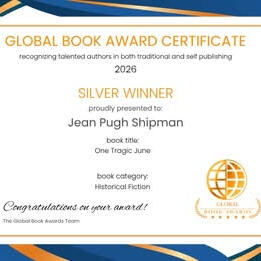
Jean Pugh Shipman
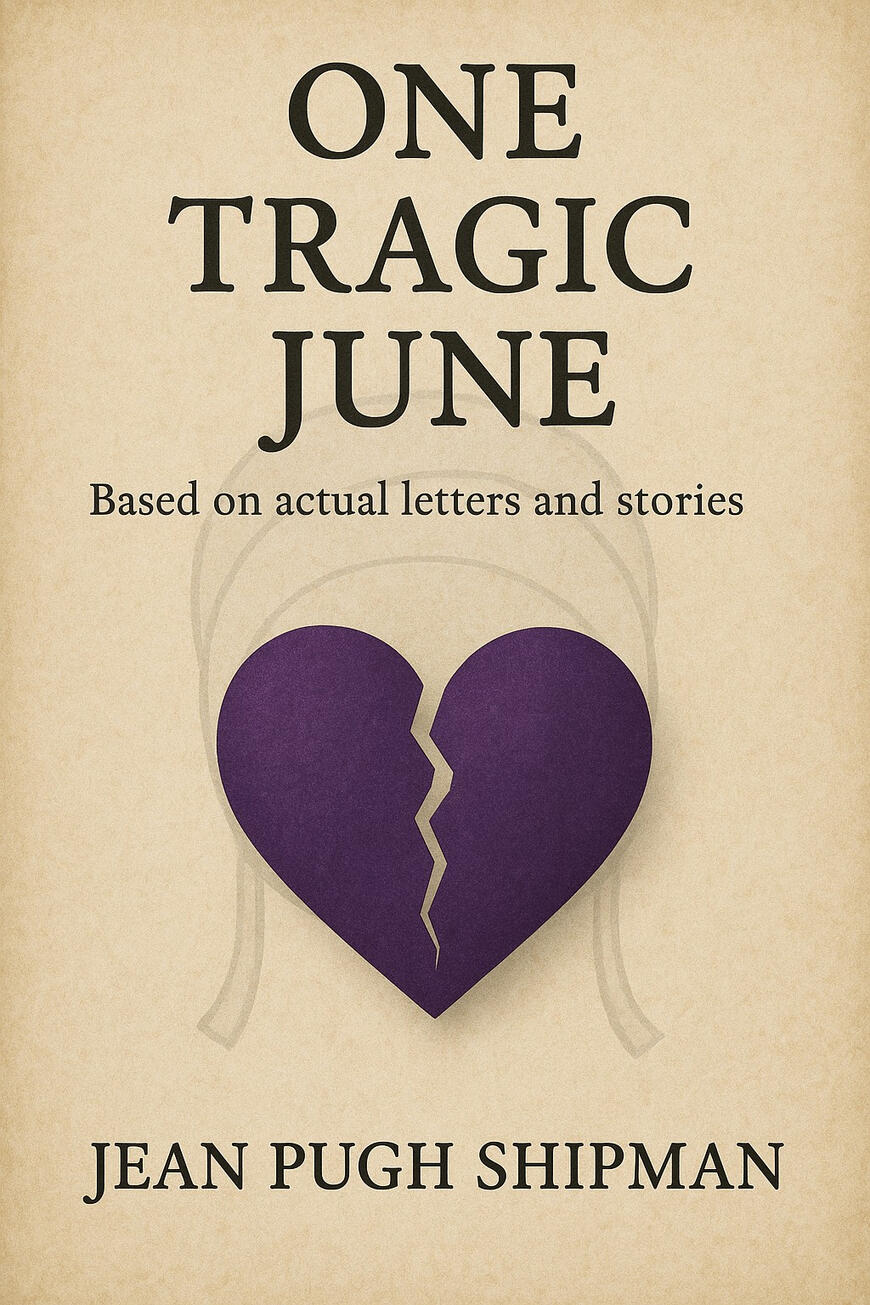
One Tragic June: Based on actual letters and stories
Welcome to my debut novel One Tragic June, a World War II forbidden love story between a Plain rural woman and an English man. This story is based on real family letters and tales from my mother's side of the family. Follow this couple's journey from their first love to their tragic endings.
Raised in a small town in Pennsylvania with family connections to the Plain religion, Jean used her experience to spin a captivating and unforgettable story of family relations, commitments, obedience, and resilience. Much of One Tragic June originates from her mother’s family letters transferred over generations (many are included in the book). Jean was a medical librarian for 40 years. This is Jean Shipman’s first novel joining two other professionally-edited books on the subjects of innovation and collaborations within health sciences libraries.

Text
REVIEWOne Tragic June by Jean Pugh Shipman is a poignant and emotionally layered historical-inspired novel that draws upon real letters and family stories to explore love, duty, faith, and the enduring consequences of choices made in times of conflict. Set against the backdrop of World War II, the narrative centers on the deeply human story of June, a woman rooted in a Plain religious community, and Peter, a man whose life path is shaped by war and service rather than tradition and expectation. At its core, the novel is a quiet but powerful exploration of forbidden love and the tension between personal desire and communal obligation. June and Peter come from vastly different worlds, both culturally and spiritually, and their relationship becomes a focal point through which broader questions of identity, belonging, and sacrifice are examined. Shipman presents their connection with sensitivity, emphasizing emotional authenticity over melodrama, which allows the story to feel grounded and sincere.One of the most compelling aspects of the book is its historical and documentary foundation. The use of actual letters and family accounts adds a sense of intimacy and realism, giving the narrative an almost archival quality. This approach deepens the emotional impact, as readers are reminded that the events are not purely fictional constructs but reflections of lived experience and generational memory. The novel also thoughtfully explores the ripple effects of June and Peter’s relationship on their families and communities. Rather than focusing solely on romance, Shipman expands the narrative to show how love, even when constrained or unfulfilled, can reshape entire family histories and social relationships. The eventual redefinition of relationships and the emergence of unexpected friendships add nuance and emotional complexity to the story.The writing style is reflective and accessible, with a gentle narrative rhythm that suits the historical tone of the material. Rather than relying on fast-paced plot developments, the novel unfolds through emotional accumulation, memory, and reflection, allowing readers to sit with the characters’ experiences and choices.One Tragic June is a heartfelt and contemplative work that will appeal to readers of historical fiction, true-inspired romance, and family sagas. It is a story about love that cannot fully exist in the form it desires, yet still leaves behind lasting echoes that shape generations.Reviewer: Jeyran Main, Review TalesBlueInkReview
Reviewed: August, 2026"One Tragic June" is a heart-rending historical novel loosely inspired by letters and stories from author Jean Pugh Shipman and her family. Set in Reading, Pennsylvania, in the early 1940s during WWII, it follows June, a teenage girl in the Plain Folk religious community, as she falls in love with a non-member and deals with the consequences.June meets Peter at a local store and slowly falls for him, even though she knows that seeing a man outside of the Plain Folk risks the community shunning her and her family. While she tries dating the son of a prominent Plain Folk member and listens to her parents’ wishes, she keeps returning to Peter, who finds ways to secretly meet her. As the story unfolds, this discreet alliance eventually spirals into tragedy for both parties.The novel is told mostly from June’s perspective, switching sometimes to Peter’s and June’s parents. June is intelligent and inquisitive about the outside world, struggling to obey her parents and her community while following her heart. Peter is bold and eager but also loving. Her parents are firm but enlightened enough to tell June about sex in age-appropriate language. Indeed, no one seems like a villain here.The novel mostly moves chronologically, with some switching in time. The introduction portrays Shipman as a girl overhearing her cousin and her own mother talking about a relative. The book is loosely based on that relative.While the story engages, the dialogue is awkward. The Plain Folk naturally speak formally. But even taking this into account, their words seem wooden: “’What a glorious day for a farm sale,’ Father says. ‘The sky is cloud free, and the sun is shining brightly. It is cold, to be sure, but it will not be freezing.’” Such stiltedness undermines the story’s flow.Still, the characterizations are nuanced and readers will appreciate the conflict of protagonists torn between religion and their feelings.Also available as an ebook.